Use the Words Your Customers Are Searching For
Learn how to use the words your customers are already searching for to make your website clearer, improve local visibility, and help more people find your business online.
Use the Words Your Customers Are Searching For
You know what your business offers. Your current customers may know what you do, too. But does your website make it immediately clear to someone who has never heard of your business?
Many small business websites use phrases such as:
Quality service you can trust
Committed to excellence
Your satisfaction is our priority
Professional service with a personal touch
These statements may sound polished, but they do not explain what the business actually does, where it operates, or who it serves.
That can create a problem for both potential customers and search engines.
When someone visits your website, they should be able to understand your services within a few seconds. Google also needs clear information so it can determine when and where your business should appear in search results.
Using the same types of words and phrases your customers are already searching for can make your website clearer, more helpful, and easier to find.
Think Like Your Customer
Business owners often describe their services differently from the way customers search for them.
You may use professional or industry-specific terms every day, but your customers may use much simpler language.
For example, a landscaper might describe a service as “residential grounds maintenance.” A homeowner, however, may search for:
Lawn care near me
Grass-cutting service in West Haven
Spring yard cleanup
Local landscaper
Someone to remove weeds from my yard
A web designer may talk about responsive development or user experience. A small business owner is more likely to search for:
Small business website designer
Affordable website design near me
Website help for my business
Local web designer
Someone to build my business website
Your website should use language that your customers recognize and understand.
This does not mean you must avoid professional terminology completely. It means your most important messages should be written in the language your ideal customers are likely to use.
Clearly Explain What You Do and Where You Do It
One of the simplest ways to improve your website is to clearly state your service and location.
These phrases tell visitors exactly what the business offers. They also give Google useful information about the services and geographic areas connected to the website.
Specific language is usually more helpful than clever language.
You can still make your website sound warm, creative, and professional. Just make sure your main headings and service descriptions are clear before adding more general marketing language.
Identify the Phrases Customers May Be Using
You do not need complicated software to begin identifying useful search phrases.
Start by writing down the services your business provides. Then consider the different ways a customer might describe each service.
For example, a landscaping company might list:
Lawn mowing
Mulching
Yard cleanup
Hedge trimming
Landscape design
Leaf removal
Snow removal
Next, add the towns or areas the business serves:
West Haven
New Haven
Milford
Orange
Hamden
You can then combine the service and location naturally:
Lawn mowing in West Haven
Yard cleanup services in Milford
Landscape design in Orange
Leaf removal in New Haven
Local landscaper serving Hamden
You can also pay attention to the questions customers ask when they call, email, or request an estimate. Their exact wording can give you valuable ideas for your website content.
If several customers ask, “Do you offer spring yard cleanups?” that service should probably be easy to find on your website.
Place Important Phrases in the Right Areas
Once you have identified the words your customers may be searching for, place them naturally throughout your website.
Important locations include:
Page Headings
Each page should have a clear main heading that explains its purpose.
For example:
Website Design for New Haven Small Businesses
This is more informative than a heading such as:
Let’s Build Something Great
The creative heading could still appear elsewhere on the page, but the main heading should clearly describe the service.
Service Descriptions
Your service descriptions should explain what is included, who the service is for, and where it is available.
For example:
“We provide lawn mowing, seasonal cleanups, mulching, and landscape maintenance for homeowners throughout West Haven and nearby communities.”
This sentence is clear, useful, and natural. It includes important information without sounding repetitive.
Page Titles
The page title is the title that may appear in Google search results and in the browser tab.
A useful page title might be:
Residential Landscaping in West Haven | Mel’s Landscaping
This tells both the customer and Google what the page is about.
Website Introductions
The first paragraph of a page should reinforce the main service and location.
For example:
“Mel’s Landscaping provides dependable residential landscaping services for homeowners in West Haven, Connecticut. From routine lawn care to seasonal yard cleanups, we help local homeowners keep their outdoor spaces looking their best.”
The paragraph sounds conversational while still including important information.
Frequently Asked Questions
Frequently asked questions are another good place to use natural search language.
Examples include:
Do you provide landscaping services in Milford?
How much does a spring yard cleanup cost?
Do you offer ongoing lawn maintenance?
Can I request a free landscaping estimate?
These questions reflect the way customers often search and speak.
Avoid Repeating the Same Phrase Too Often
Using helpful phrases does not mean repeating the same sentence throughout the page.
A website that repeatedly says “West Haven landscaping services” in every paragraph will sound awkward and unnatural.
Google’s goal is to provide useful results to people. Your content should therefore be written for people first.
Use variations when appropriate.
For example, instead of repeating the exact phrase “West Haven landscaper,” you might naturally use:
Local landscaping company
Residential lawn care
Landscaping services in West Haven
Yard maintenance for local homeowners
Lawn and garden services
Landscaping professionals serving the area
These related phrases add variety and make the content more pleasant to read.
The goal is clarity, not repetition.
Create Separate Pages for Important Services
If your business offers several major services, consider creating a separate page for each one.
A landscaping company might have individual pages for:
Lawn care
Seasonal yard cleanup
Mulching
Hedge trimming
Landscape design
A beauty and wellness business might create pages for:
Manicures
Pedicures
Gel nails
Facials
Waxing
Eyelash extensions
Each page can focus on the specific questions and phrases connected to that service.
This also allows customers to land directly on the page that best matches what they searched for.
Someone searching for “gel manicures in Milford” should not have to read through a long page covering every salon service before finding the information they need.
Do Not Forget About Nearby Towns
Local businesses often serve more than one community.
Your website should clearly identify your primary location and the nearby areas you serve. This information can appear on your homepage, service pages, contact page, and service-area section.
For example:
“We provide residential landscaping services in West Haven, New Haven, Orange, Milford, and nearby Connecticut communities.”
For important locations, you may eventually create individual local service pages. However, each page should include useful and unique information. Avoid copying the same page and simply replacing the name of the town.
A page for Milford customers might discuss the specific services you provide in Milford, the types of customers you serve, and how someone in that area can request an estimate.
Clear Language Builds Trust
Using specific language is not only helpful for search engines. It also helps customers feel confident that they have found the right business.
Imagine someone searching for a local plumber because a pipe is leaking. They are likely to trust a website that immediately says:
Emergency Plumbing Services in Orange, Connecticut
They may be less confident in a website that only says:
Solutions You Can Count On
The first heading answers an urgent question: “Does this company provide the service I need in my area?”
Clear language reduces confusion and makes it easier for visitors to take the next step.
Review Your Website One Page at a Time
You do not need to rewrite your entire website at once.
Start with your homepage and ask:
Does the main heading clearly explain what we do?
Does the page identify where we provide services?
Would a new visitor understand the business within a few seconds?
Are the service descriptions specific?
Are important services easy to find?
Does each page have a clear purpose?
Then review your service pages, About page, and contact page.
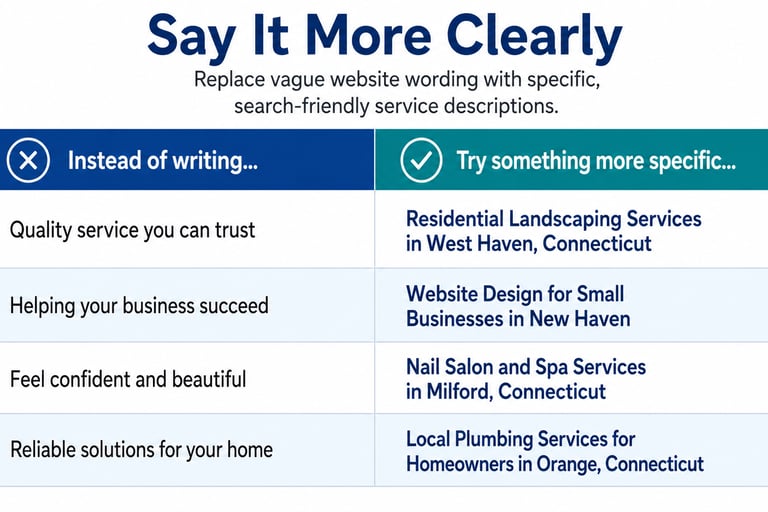
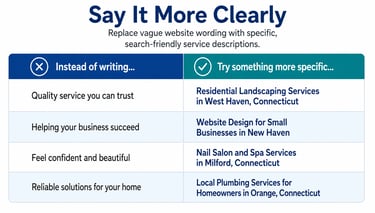
Replace vague statements with clear descriptions wherever possible.
Instead of:
We bring your vision to life
Try:
Custom Website Design for Local Service Businesses
Instead of:
Experience the difference
Try:
Professional Nail and Spa Services in Milford
You can still use creative phrases as supporting text. Just do not make customers guess what your business offers.
Start With Clarity
Getting found online begins with making your business easy to understand.
Use the words your customers are already using. Clearly explain what you do, where you do it, and who you serve. Place those phrases naturally in your headings, service descriptions, page titles, and website content.
Avoid filling your pages with repetitive phrases or writing only for search engines. Your website should sound helpful, natural, and human.
When your website clearly communicates your services and location, you make it easier for Google to understand your business—and easier for the right customers to find and choose you.
Sitemap
Get in Touch
contact@woodlanddigitallabs.com
(203) 388-6830
Mon - Fri: 9:00 AM - 5:00 PM
© 2026 Woodland Digital Labs-All Rights Reserved
Private Policy | Terms of Use
WE SPEAK FLUENT HUMAN
Website Design, SEO & Lead Generation for Small Businesses in New Haven County, CT